(no subject)

Feb. 15th, 2026 06:00 pm
yigal_s: (Default)
[personal profile] yigal_s
Тут запиратили недавно изданный учебник "A First Graduate Course in Quantum Field Theory: For Doctoral Level Physics" совершенно героического инженера и ученого Travis S. Taylor, обладателя аж 2х PhD, который сейчас ещё третий делает, по физике.

Делать курс QFT для докторантов, самому заканчивая аспирантуру - это безусловно отдельный героизм. Ну, в принципе, так наверное даже проще, по свежим ещё впечатлениям от собственной учебы, но всё ж такое не каждому дано. Обычно авторы из последних сил стараются сделать курс QFT доступный для Undergraduates, а тут на тебе, ровно наоборот.

Хотя формулы в формате EPUB читать практически невозможно, я всё же сделал попытку ознакомиться с вводными главами, и немало прифигел, обнаружив, что автор эпизодически выдаёт про обычную квантовую механику какую-то совершенную дичь, будто студент, капитально не подготовившийся к экзамену. Отчасти снова же героическую, например, иллюстрируя принцип суперпозиции не много не мало отсылкой к эксперименту с котом Шредингера (он его сам, что ли, проделал?).

В общем, подберу упавшую челюсть с пола, и подожду формата pdf, не догоню, так хоть посмеюсь ещё немного.

Ну и, для протокола, из тоже недавно вышедшего
"Elementary Particle Physics" Iliopoulos - вроде ничего книжка, с душой написано. Но, не шмогла.
"Spaces and Dimensions of Quantum Fields" - George Tsoupros, в нашу Колхозную )) библиотеку пока не доставили.
[syndicated profile] danielgreenfield_feed

Posted by Daniel Greenfield


Senator Saddam claims that Virginia is in the middle of an ‘Islamophobia’ crisis. The second Muslim selected for the state senate, after Ghazala Hashmi, who is now acting as Virginia’s Lt. Governor, the Bangladeshi immigrant, from a country where non-Muslims are being murdered in the streets, has made complaining about ‘Islamophobia’ in his new home his signature issue.

Sen. Saddam Azlan Salim’s first priority has been a bill to define ‘Islamophobia’. The most notable thing about his bill SB 624 ‘Assault and battery; definition of “Islamophobia”, penalty’ is how completely unnecessary it is. Virginia already has multiple layers of hate crimes enhancements for assaults motivated by race, ethnicity and religion. During Gov. Glenn Youngkin’s term, the legislature has already passed SB 7 (Senate Bill 7) and its counterpart enhancing the assault charge for anyone who “intentionally selects the person against whom a simple assault is committed because of his race, religious conviction, gender, disability, gender identity, sexual orientation, color, or ethnic or national origin.”

That should cover Islam and Muslims. And yet Sen. Saddam introduced a 3 page bill with 10 clauses in its first section a whole lot of whom do nothing more than add (including Islam) where it isn’t remotely needed or useful. For example “because of his race, religious conviction (including Islam), gender, disability, gender identity” or “because of his race, religious conviction (including Islam)”. Islam appears to be the only religion being singled out this way.

Why provide Islam with this privileged status? Because it makes Islam distinct, which is a step towards making it superior, and making Islam distinct and superior is the religious mission of all believing Muslims.

This isn’t about making sure that attacks on Muslims are prosecuted, but about providing Islam with special privileges.

And it’s about using supposed crimes against Muslims as bait for Islamophobia indoctrination. The Islamophobia ‘switch’ in SB 624 comes after the ‘bait’ about assaults. First, the bill sets out a definition of ‘Islamophobia’ which transforms a term created by Islamists seeking to impose their religion on society into an official legal term.

Notably, the definition in SB624 states that “Islamophobia means malicious prejudice or hatred directed toward Islam or Muslims.” This distinction is legally significant as ‘prejudice’ towards Islam distinct from prejudice towards Muslims. For example, in the UK burning a Koran has been prosecuted as a form of hate towards Islam. And that opens the door to blasphemy law.

Having malicious prejudice towards Muslims is perfectly sufficient in prosecuting an assault or a case of discrimination. Islam however is a religion and just like any religion or any other belief system, people have the right to be opposed to it as long as they don’t mistreat others.

The use of “Islam or Muslims” embeds the first stage of blasphemy law inside Virginia law.

But that’s the whole reason why ‘Islamophobia’ was manufactured as a political term. Unlike ‘racism’ or ‘antisemitism’, it’s not hatred towards a group, but towards an ideological abstraction. ‘Islamophobia’ legislation isn’t protecting persecuted individuals, but the status of an ideology. And those forms of ‘protection’ invariably turn out to ban ‘blasphemy’ against Islam by censoring cartoons, art (at least one art professor was fired for showing paintings of Mohammed in class) and any public criticism of the Islamic persecution of women, minorities and all non-Muslims.

SB 624 claims that it’s not trying to “regulate or restrict any speech, expression, or belief”, but by including a definition of ‘Islamophobia’ that mentions ‘Islam’ and puts it first, it’s laying the groundwork for doing exactly that.

Compare this to HB 2261 under Gov. Youngkin, which Islamist and leftist groups urgently opposed, which defined antisemitism and which did not mention ‘Judaism’, but rather defined it as a “hatred toward Jews and includes rhetorical and physical manifestations of hostility or hatred that may be directed toward Jewish or non-Jewish individuals or their property, the Jewish community, or Jewish institutions and religious facilities.” In all of these cases, antisemitism involved hatred against Jews, synagogues or other facilities, not ‘Judaism’.

Why doesn’t Sen. Saddam’s ‘Islamophobia’ bill use that as a model? Because it’s not about protecting Muslims from violence, but about imposing Islam as a legal concept on Virginia.

The object of SB 624 and every effort to define ‘Islamophobia’ isn’t Muslims, it’s Islam. The pretense that Muslims are facing violence and need a new bill to protect them falls apart because the very definition is aimed at protecting ‘Islam’, the religion, not the individuals.

Virginia’s extensive hate crime codes already amply protect Muslims from anything and everything. The only ‘gap’, from the Islamist perspective, is the status of Islam.

The ‘Islamophobia’ definition of SB 624 gives a distinct and special status to Islam, it defines Islam as an entity that must be protected by the government and the law enforcement agencies whom the bill obligates to use this definition of ‘Islamophobia’ when prosecuting hate crimes. And that paves the way for criminalizing Koran defacement and Mohammed paintings.

It’s telling that Virginia’s highest profile ‘Islamophobia’ case was a lie. And it happened in Fairfax County, which is represented by Sen. Saddam Azlan Salim. Darwin Martinez Torres, an illegal alien MS-13 gang member, killed Nabra Hassanen, a Muslim teenage girl, and rather than blaming Fairfax’s sanctuary policies that enabled Torres to be there roaming the streets, Islamist groups and their radical allies falsely blamed ‘Islamophobia’ and intimidated local authorities, including prosecutors, into propping up their hoax. Police initially correctly stated that it was road rage before being forced to spread the lie that it had been motivated by Islam.

The evidence that it was a ‘hate crime’?

In the words of a Washington Post reporter “hitting a 17-year-old girl with a bat and dumping her body in a pond would be an act born of hate.” Perhaps, but not of Muslims or of Islam.

Nabra Hassanen’s murder was used to promote the myth that there was an ‘Islamophobia’ crisis in Virginia and SB 624 is the next stage in which Islamists profit by creating a distinct legal status for Islam. That is how one lie about ‘Islamophobia’ becomes a state law.


Daniel Greenfield is a Shillman Journalism Fellow at the David Horowitz Freedom Center. This article previously appeared at the Center's Front Page Magazine.

Thank you for reading. 


Read my book 'Domestic Enemies: The Founding Fathers' Fight Against the Left' to discover the true origins of the American Left.


juan_gandhi: (Default)
[personal profile] juan_gandhi
 "Как по искуплении всех нужных вещей случилось нам обедать тут, в трактире, то в самое то время, и власно, как нарочно, для удовольствования моего любопытства, пришел туда человек с прошпективическим ящиком, в котором, сквозь стекло, показывают разные прошпективические виды городам, и который многие у нас неправильно называют каморою-обскурою. Мне сего оптического инструмента никогда еще до того времени не случалось не только видать, но и слышать, что он есть на свете, и — Боже мой — с каким это удовольствием, радостью и любопытством смотрел я в него и любовался толь живо и, власно, как в натуре изображающимися в оном видами знаменитейших городов в свете и наилучших в них зданий и улиц. Словом, я прыгал почти от радости, получив случай их, хотя на бумаге, видеть и получить о них некоторое понятие. Я не мог устать, пересматривая все его картины и рассматривая самое устроение сей машины, которая мне показалась весьма проста и без дальней хитрости сделанною, и с превеликою охотою заплатил то небольшое число денег, которое следовало дать показывавшему нам оные и питающемуся тем человеку."

src

(no subject)

Feb. 15th, 2026 06:40 pm
[syndicated profile] galchi_feed
.

Снег

Полюбил бы я зиму,
Да обуза тяжка…
От нее даже дыму
Не уйти в облака.


Эта резанность линий,
Этот грузный полет,
Этот нищенски синий
И заплаканный лед!

Но люблю ослабелый
От заоблачных нег —
То сверкающе белый,
То сиреневый снег…

И особенно талый,
Когда, выси открыв,
Он ложится усталый
На скользящий обрыв,

Точно стада в тумане
Непорочные сны —
На сомнительной грани
Всесожженья весны.


Иннокентий Анненский,
1910.


рыбка!

Feb. 15th, 2026 08:38 pm
avva: (Default)
[personal profile] avva


Понравилась эта задача от Александра Шеня (увидел в записи Юрия Подкопаева в ФБ). Вообще я очень боюсь таких задач, потому что знаю про себя, что практически нет пространственного воображения. Но тут оказалась ситуация "у страха глаза велики" - заставил себя внимательно подумать и представить, глядя на картинки, и быстро все получилось.

Но вот что бы могло оказаться полезным, как мне кажется, это серия такого рода задач, градуированных по сложности. Чтобы найти свой потолок и постучать по нему снизу как следует, авось и поднимется. Может, кто-то встречал такое?
pargentum: (Default)
[personal profile] pargentum
По данным Банка России, в 2025 году было зафиксировано рекордное количество хищений со счетов в банках: впервые за всю историю наблюдений их количество превысило отметку в 1,5 млн операций.
[syndicated profile] philg_feed

Posted by philg

This is about a January 2-12, 2026 trip on the Celebrity Ascent from/to Fort Lauderdale via the following ports:

  • Tortola, British Virgin Islands
  • St. Johns, Antigua
  • Barbados
  • St. Lucia
  • St. Kitts

TL;DR: It’s a big ship, but you feel like family. The officers and staff are warm and friendly. The food is much better than on Royal Caribbean. The ship orchestra and the house band (Blue Jays with Jessica Gabrielle) were superb.

The Machine

Celebrity Ascent was completed in 2023 by Chantiers de l’Atlantique at a cost of $1.2 billion and holds about 3,300 passengers on a typical cruise, plus 1,400 crew. She’s notable for having a “Magic Carpet” that can slide up and down the ship, serving as a restaurant or bar most of the time, but also an embarkation platform for the ship’s tenders at ports where there isn’t a pier.

I don’t think she’ll win any beauty contests, but Ascent is very functional! In St. Lucia:

Note that there is no place on board to land a helicopter. If someone gets sick and needs to be evacuated, only the Coast Guard or one of the private contractors that the Europeans like to use can extract someone from the ship with a hoist.

Despite the potential of Starlink, Internet service actually provisioned was too slow for work (see Celebrity Starlink Wi-Fi Internet (3 Mbps at $1,000 per month)).

With 73,000 hp of Wärtsilä diesel power (five engines total), I’m not sure that Greta Thunberg will want to be a customer. That said, the hull design is 22 percent more fuel efficient than older ships. How is it possible to advance the art of naval architecture, already relatively mature during the Second Punic War (2,250 years ago)? The efficiency doesn’t come from an improved hull shape, but from pushing air out at the bow and, thus, enabling the ship to ride on a cushion of air rather than clawing at the draggy water. Prof. Dr. ChatGPT, Ph.D. Naval Arch. explains:

Modern cruise ships sometimes use air lubrication systems (ALS) that pump compressed air through tiny openings in the hull—usually along the flat bottom.

1. Reduced Skin-Friction Drag

  • Water is ~800× denser and far more viscous than air.
  • Replacing direct water–steel contact with air–water contact drastically lowers friction.
  • Skin friction accounts for 50–80% of total resistance at cruise speeds.

2. Lower Fuel Consumption

Typical real-world savings:

  • 5–10% fuel reduction on large ships
  • Sometimes higher on wide, flat-bottomed hulls (like cruise ships)

Many modern ships include air lubrication, including vessels from:

  • Mitsubishi Heavy Industries
  • Wärtsilä
  • Silverstream Technologies

Some notable cruise lines have retrofitted ALS systems to existing ships to improve efficiency.

Air-bubble (air-lubrication) systems have a longer history than most people realize—they date back over half a century, but only became practical for cruise ships fairly recently.

Air lubrication always worked—but it needed:

  • Cheap, efficient electrical power onboard
  • Sophisticated control software
  • Environmental pressure (fuel cost + emissions)
  • Better hull designs to keep the air where it belongs

Cruise ships finally ticked all the boxes.

The Stateroom

Booking about three weeks before departure we got literally the last room available on the ship, other than an inside cabin. We had a Concierge Class 285-square-foot stateroom including the veranda, which ends up becoming part of the room because of the top glass panel’s ability to slide vertically. It’s a clever design. Our room was laid out like the photo below, except that we had the two halves of the bed split with a night table in between. We could have used outlets on both sides of the bed, but found an outlet on only one side. The bathroom felt spacious.

The in-room HVAC doesn’t dehumidify as much as one would expect, nor does it bring significant fresh air into the room when the veranda window is sealed. Humidity without the window open would range from 50-65% (how do they avoid mold?) and CO2 levels in the middle of the night would go over 1,300 ppm (a real nightmare for Greta Thunberg!). Data from an Airthings Wave Enhance:

(I’ve seen CO2 go to 1,000 ppm in some hotels in humid environments, such as Miami. The ASHRAE standard is 800-1,000 ppm. CO2 by itself isn’t harmful (up to 5,000 ppm is tolerated in submarines), but is an indication of how much fresh air is coming in. Atmospheric CO2 is about 430 ppm. In my old Harvard Square condo (crummy 1880s construction) with just one person in the bedroom (me), the CO2 level reached 700 ppm in the middle of the night.)

The Passengers

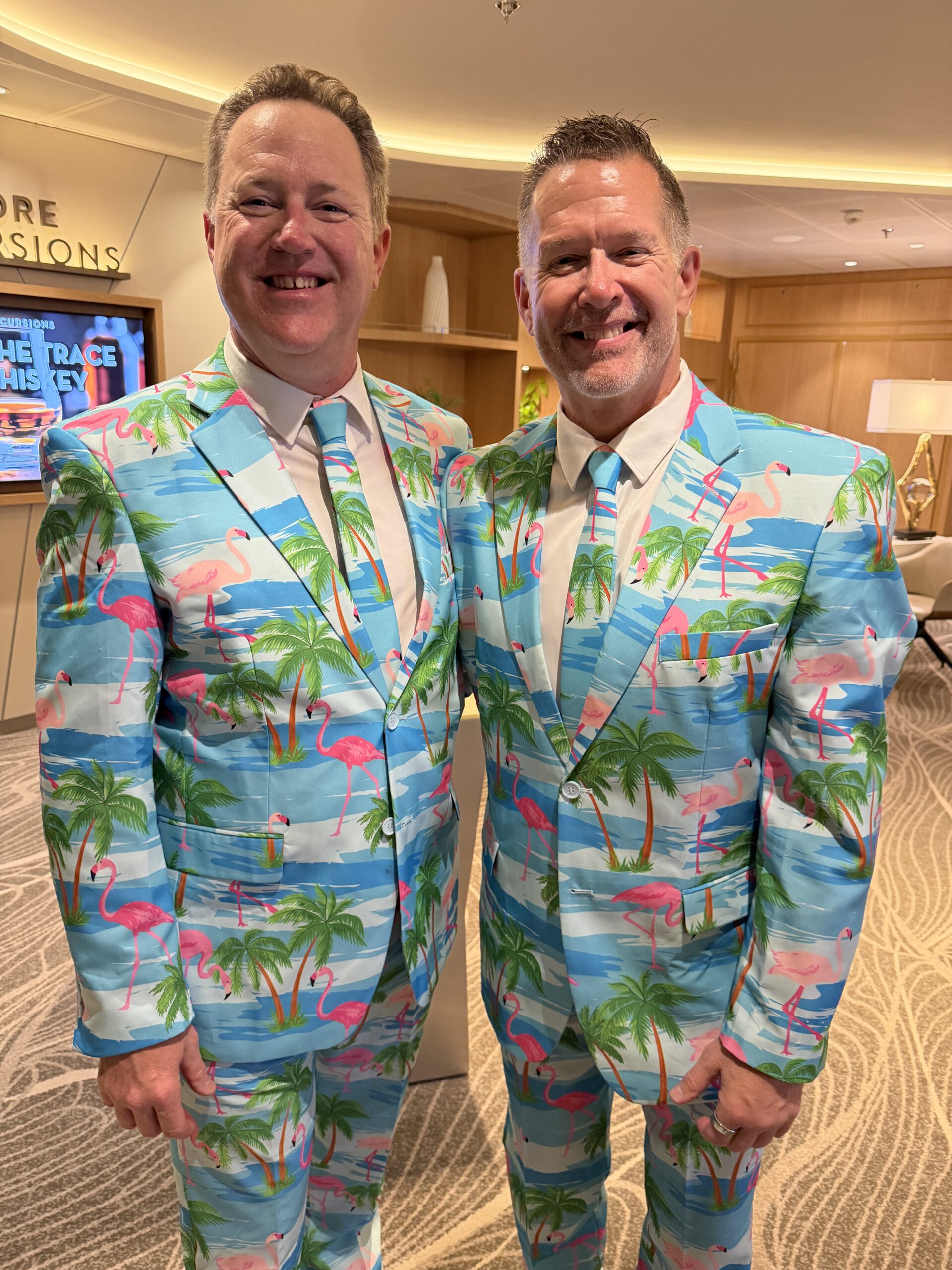
Typical passengers seemed to be the same kinds of folks who would move into the The Villages (the most active over-55 active community in the U.S.?). Here are a couple of brothers who were, I think, traveling with their parents (flamingo suits from Amazon):

Exercise on Board

There is a beautiful and never-crowded gym on Deck 15 looking straight out at the sea in front of the ship:

Ascent lacks the “walking/jogging track all the way around Deck 5” that was a conventional exercise solution on older ships and instead has a bizarre serpentine track on (crowded) Decks 15 and 16 that is also used by people getting to and from lounge chairs. The lack of the conventional all-around-the-ship track was my biggest disappointment, which I guess means that everything else was at least pretty good!

Here’s the track. Notice that it isn’t shaded, unlike the typical round-the-ship track, and it is surrounded by clutter and people. (The Magic Carpet is in the background in its higher position.)

Food

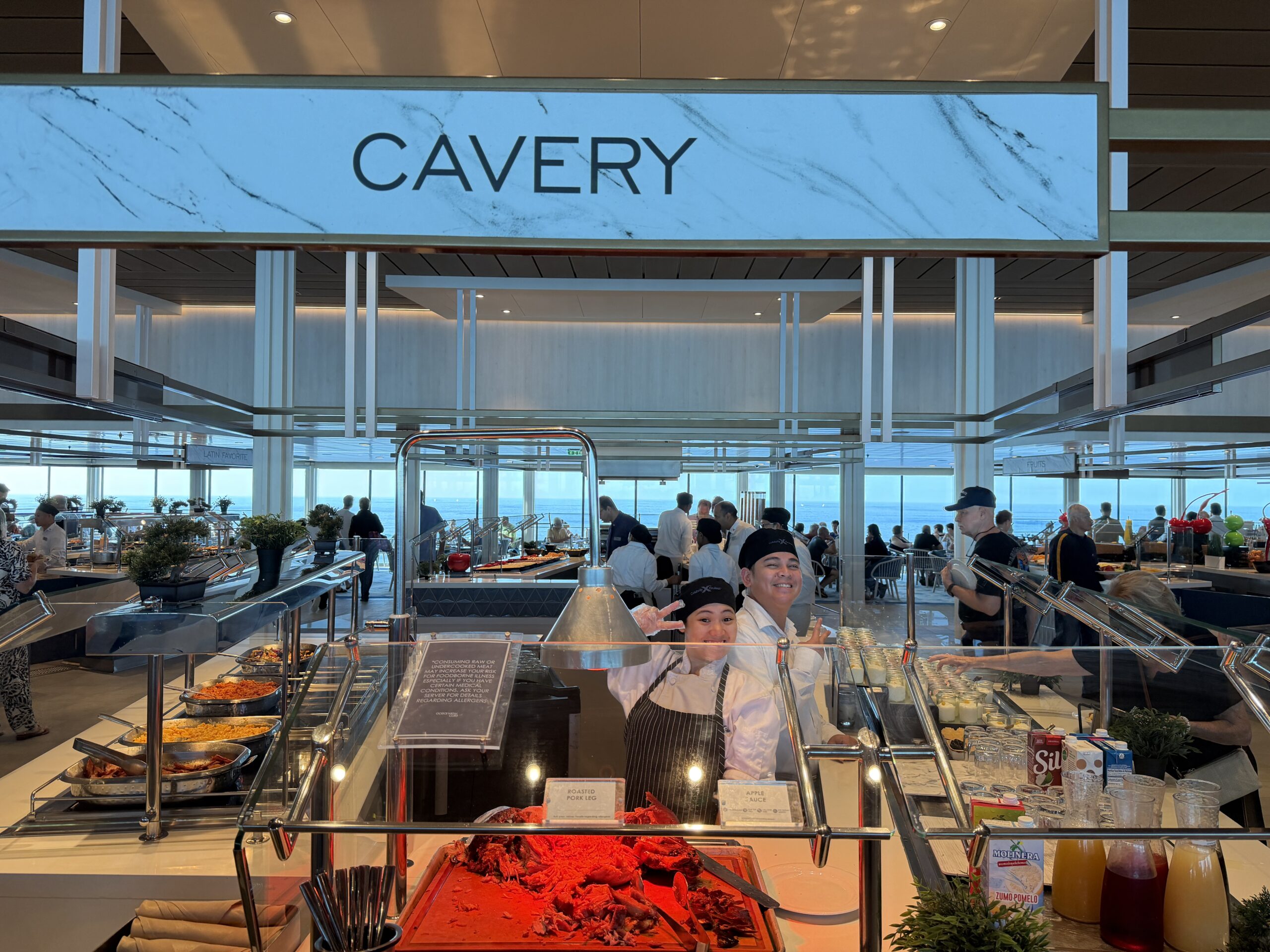
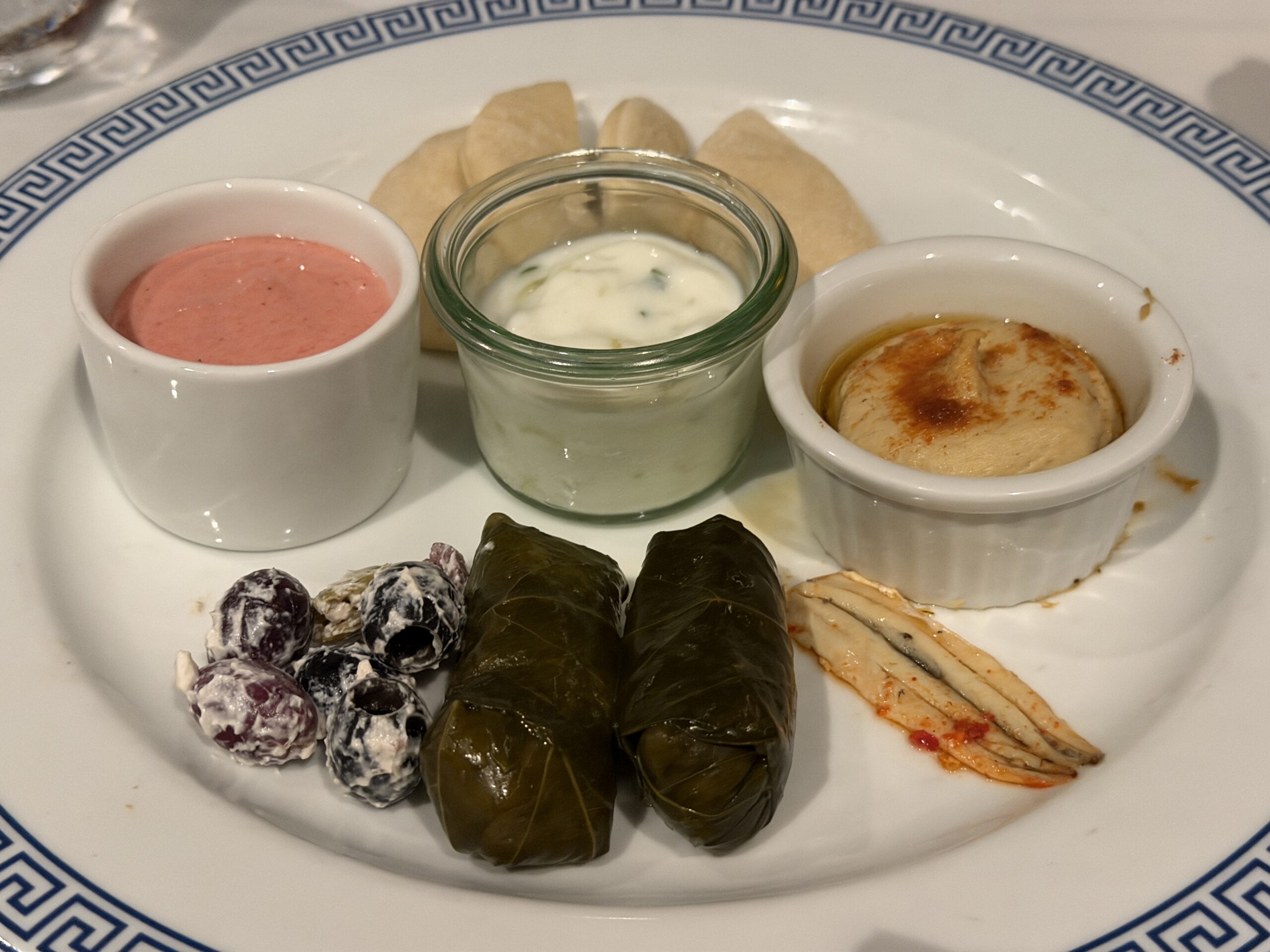
The food is a significant step-up from what’s offered on Royal Caribbean, the parent company of which acquired Celebrity in 1997. This is good and bad, I guess, I lost weight during every Royal cruise and gained some weight on this Celebrity trip.

One important source of weight gain was that, unlike almost anyone in the U.S. and certainly unlike anyone on Royal, the baker for Ascent was able to make a high quality croissant. These were hard to resist at breakfast. (Fortunately, they were just as bad as Royal at making donuts! The worst Dunkin’ does a better job.) Then at about half the other meals in the buffet they had addictive bread pudding. There was always an option for Indian food at the buffet (4 or 5 dishes plus bread) and typically at least two or three other Asian choices.

A friend who owns some superb restaurants did the Retreat class on Celebrity and said that the dedicated restaurant for those elite passengers exceeded his expectations. We hit the specialty steak restaurant on Ascent and were somewhat disappointed. They can’t have a gas grill on board for safety reasons and, apparently, don’t know how to use induction and a cast iron pan. The steaks are, therefore, rather soggy. We ate in the main dining room and buffet restaurants after that.

The Pool

There’s an indoor solarium pool for Alaska and European cruises. Here’s the outdoor pool (big enough for water aerobics and kids to goof around; not really big enough to swim for exercise (though it emptied out towards sunset so maybe one could)):

Still open and empty because everyone is dressing for dinner?

There are some hot tubs, but they’re not quite hot enough (i.e., you could comfortably sit in one for an hour):

The Spa

If you’re doing an Alaska cruise it probably would make sense to pay for Aqua Class, which includes access to these heated loungers looking out at the sea (not all that appealing on a Caribbean cruise!). The SEA Thermal Suite:

Sports under the Stars

Our cruise coincided with NFL playoffs and people enjoyed the big screen experience in the “Rooftop Garden”:

Entertainment

The resident musicians, singers, and dancers were all great. I personally wish that cruise lines would do full plays or musicals rather than assemble songs from disparate sources and string them together, but apparently I’m a minority of one and attention spans dictate that shows last for just 45 minutes. Some of the guest stars were fantastic, notably Stephen Barry, an Irish singer with a fun attitude. Steve Valentine did a mind-bending Vegas-quality magic show. The technical aspects of the theater were up to Broadway standards or beyond.

Some of my favorite shows were ones where the ship’s orchestra got together with one of the singers from a smaller group and just played music. I’m more of a classical music fan, but the high level of talent live was compelling.

For Kids

There is a small Camp at Sea for kid kids, which some of the youngsters on board seemed to like. My 16-year-old companion rejected the Teen Club, finding only boys playing videogames.

Unlike on Royal Caribbean, there weren’t many under-18s on board. That said, I never saw a child or teen who seemed bored or unhappy. They were loving the food, the scenery, the pool, etc.

The Bridge

The bridge is worth seeing. It’s a masterpiece of ergonomics. Apparently, the captain takes direct control of the Azipods when docking. I had expected a joystick and a computer to figure out what to do with the bow thrusters and the Azipods, but that’s not how it is done.

The Dancers (Bear+Woman)

Art imitates life (“Based on May 2024 surveys, approximately 31% to 37% of women in the US and UK indicated they would prefer to be alone in the woods with a bear over a strange man, with higher rates among younger women (up to 53% for 18-29 year olds in the UK).”):

Conclusion

The whole trip cost about $8,000 including all of the extras, such as Internet and a couple of shore excursions, but no drinks package and only a few extra-cost drinks. We could have done it for less if we’d booked farther ahead or chosen a more basic room. It worked out to $800 per day for great scenery, fun entertainment, more food than I should have eaten, and an introduction to five islands, three of which were entirely new to me and the other two that I hadn’t visited for more than 20 years.

I will remember the warmth of the Celebrity crew. Everyone seemed genuinely interested in welcoming and taking care of us.

[For the cruise haters: We could have flown to a Caribbean from FLL, stayed in a hotel, picked restaurants, and flown back, for about the same price (or 50 percent more for the same level of luxury?). The boat ride itself has value to me, however. I love to be on deck when arriving or departing. It’s a different kind of understanding of how the Caribbean is put together geographically and culturally than one might get from being airdropped by Airbus A320.]

The post Celebrity Ascent Southern Caribbean cruise review appeared first on Philip Greenspun’s Weblog.

[syndicated profile] galchi_feed


15 февраля, Сретение Господне.

"Сустретьев день" (из "Русского земледельческого календаря" - так еще называли Сретение)


nravov: (Default)
[personal profile] nravov
Нож гильотины движется вертикально вниз со скоростью в половину скорости света. Угол между лезвием ножа и листом бумаги расположенным горизонтально мал.

Тогда точка разреза будет двигаться вдоль листа со сверхсветовой скоростью.

Микроэкономическое

Feb. 15th, 2026 04:52 pm
chaource: (Default)
[personal profile] chaource
Думаю вотъ записать такой недавно обнаруженный мной фактъ.

Если вы живете въ Европѣ и къ вамъ домой пришелъ отъ обслуживающей фирмы сантехникъ, электрикъ, или другой рабочiй и что-то починилъ и выставилъ оффицiальный счетъ отъ фирмы, то изъ заплаченныхъ вами денегъ примѣрно двѣ трети уйдетъ въ налоги. Рабочему останется лишь около трети.

Поэтому, если работникъ дѣйствительно то, что надо отремонтировалъ, то лучше всего заплатить работнику наличными безъ выставленiя счета, чтобы помочь ему скрыть этотъ доходъ отъ налоговой службы.

Вотъ примѣрный расчетъ.
Read more... )
the_jubjub_bird: (Default)
[personal profile] the_jubjub_bird
И поехали на побережье в Botany Bay (не тот, который в Австралии, а наш, Кентский). Пофотографировали немного.
20260214_132418.jpg
20260214_141312.jpg
20260214_132428.jpg
20260214_135533.jpg
20260214_132443.jpg
20260214_132315.jpg
20260214_134323.jpg
20260214_132951.jpg
20260214_133953.jpg
20260214_134159.jpg
20260214_134053.jpg
20260214_132432.jpg
20260214_132735.jpg
20260214_132325.jpg
20260214_132423.jpg
20260214_135551.jpg
20260214_140955.jpg
20260214_135118.jpg
20260214_135138.jpg
20260214_134959.jpg
20260214_132945.jpg
20260214_133949.jpg
20260214_134102.jpg
20260214_134000.jpg
20260214_132438.jpg
20260214_134206.jpg
20260214_140958.jpg

Why Everyone Else Is Wrong

Feb. 15th, 2026 02:00 pm
[syndicated profile] amren_feed

Posted by Jared Taylor


Subscribe to future audio versions of AmRen articles here.

Jonathan Haidt, The Righteous Mind: Why Good People Are Divided by Politics and Religion, Pantheon Books, 419 pp., $27.95.

This book begins with a quotation from Spinoza — “I have striven not to laugh at human actions, not weep at them, not to hate them, but to understand them” — and the author does his best to do likewise. Jonathan Haidt, who teaches at New York University after many years at the University of Virginia, has tried to figure out how morality really works, not how it should work. To that end, he leads the reader on a fascinating tour of the roles of reason and emotion, the purpose of religion, why groups are important, how liberals differ from conservatives, and why well-meaning people so often disagree.
Prof. Haidt had to suppress his instinctive liberalism in order to follow where the evidence leads, and did so with considerable bravery: How many social scientists would argue that religion is important and that we build atheist societies at our peril? Or that liberalism is based on a dangerously narrow moral foundation? This book is like another one recently reviewed here, Pathological Altruism, in that it does not directly address the race question, but some of the light it sheds shines our way.

A critique of pure reason

One of Prof. Haidt’s most interesting arguments is about the nature of moral reasoning:

If you think moral reasoning is something we do to figure out the truth, you’ll be constantly frustrated by how foolish, biased, and illogical people become when they disagree with you. But if you think about moral reasoning as a skill we humans evolved to further our social agendas — to justify our own actions and to defend the teams we belong to — then things will make a lot more sense. Keep your eye on the intuitions and don’t take people’s moral arguments at face value. They’re mostly post hoc constructions made up on the fly, crafted to advance one or more strategic objectives.

Often, the mental exercises we think are truth-seeking are really excuse-making.

Ever since Plato, Western thinkers have argued that reason can dominate the emotions and lead to virtue. Almost all the greatest mischief makers — Karl Marx, Franz Boas, Margaret Meade, Gunnar Myrdal, Jonathan Kozol, Steven Jay Gould, and virtually every social science department in America — have gone farther and claimed there is no such thing as human nature, so we can reason our way to utopia. As Prof. Haidt notes, radical reformers have to believe the mind is a blank slate if they are to write their fantasies on it.

Science now recognizes that the mind is far from blank. We are strongly motivated by fear, disgust, anger, affection, sympathy, and loyalty in ways that have been sharply defined by evolution. Reason is a newcomer:

Animal brains are constantly appraising the environment and making instant decisions about how to get more of the good things out there and less of the bad. Automatic processes run the human mind, just as they have been running animal minds for 500 million years, so they’re very good at what they do . . . . When human beings evolved the capacity for language and reasoning at some point in the last million years, the brain did not rewire itself to hand over the reins to a new and inexperienced charioteer.

Prof. Haidt develops this idea further with an analogy of an elephant and its rider — “thinking is the rider, affect is the elephant” — but the rider serves the elephant and only occasionally tells it where to go. The rider has the ability to consider options and think about the future so he is useful to the elephant, but the elephant — like other animals — mostly runs on instinct. The rider is also “skilled at fabricating post hoc explanations for whatever the elephant has just done, and it is good at finding reasons to justify whatever the elephant wants to do next.”

The emotional processing that drives the elephant is intuitive. For example, people draw conclusions about the attractiveness and competence of someone after seeing his picture for a tenth of a second. Our instincts are immediate — the elephant begins to lean one way or the other — and the rider cobbles together moral justifications only afterwards.

One of the most important functions of the rider is to make the elephant look good: “Once human beings developed language and began to use it to gossip about each other, it became extremely valuable for elephants to carry around on their backs a full-time public relations firm.” The social aspect of moral reasoning is crucial. If we were solitary animals, we would not need moral reasoning; simply wanting to do something would be reason enough for doing it. The real purpose of morality is to justify our own actions to others and to set up rules to compel them to act as we say they should. Moral reasoning is not a means to objective truth but is, as Prof. Haidt explains, “part of our lifelong struggle to win friends and influence people.”

Prof. Haidt says that the conscious mind is a spin artist: “We are indeed selfish hypocrites, so skilled at putting on a show of virtue that we fool even ourselves.” Being (or just appearing to be) right is a major human goal: “An obsession with righteousness (leading inevitably to self-righteousness) is the normal human condition.” We care more about our reputations and having our own way than we do about the facts: “Our moral thinking is much more like a politician searching for votes than a scientist searching for truth.”

What Prof. Haidt is saying nicely sums up people with whom we disagree, doesn’t it? But surely, it doesn’t apply to us or our friends! There may be a handful of people who can judge their own motives perfectly, whose opinions are never swayed by personal interests, who unhesitatingly tell the truth even if damages them. Chances are, we are not among them.

It is because of our partisan minds that we read books we expect to agree with. That is why we spend more time with people like ourselves than with people with different politics. Once we have taken a position it becomes very difficult to change. We become full-time lawyers, looking for the evidence that supports us and ignoring the rest.

Prof. Haidt writes that whenever people have the slightest interest in an outcome, they can be counted on to “reason” it out to their own advantage — and to believe they have been perfectly objective. He says you get truth only when “a large number of flawed and limited minds battle it out.”

This is why people are so good at finding holes in other people’s arguments but cannot see the flaws in their own. Brain scan studies find that when we are presented with evidence that contradicts something we strongly believe, we do not activate the parts of the brain involved in calm reasoning. Instead, emotion-related areas light up — the parts of the brain involved in negative emotions and responses to punishment. The brain comforts itself by activating reward circuitry. As Prof. Haidt explains:

[P]artisans may be simply unable to stop believing weird things. The partisan brain has been reinforced so many times for performing mental contortions that free it from unwanted beliefs. Extreme partisanship may be literally addictive.

This is why arguments are so unproductive. Moral reasoning is like a dog’s tail: “You can’t make a dog happy by forcibly wagging its tail. And you can’t change people’s minds by utterly refuting their arguments.” If your arguments ever convince anyone, it is only after you have taken the trouble fully to understand what he feels and thinks: “It’s such an obvious point, yet few of us apply it in moral and political arguments because our righteous minds so readily shift into combat mode.”

Most of the time, says Prof. Haidt, “if you want to change people’s minds, you’ve got to talk to their elephants,” and you don’t do that with reason. You do it by showing yourself to be a warm, attractive person. When you draw someone in emotionally, his elephant begins to lean your way, and the rider starts paying attention to what you say. This is how many people become dissidents on race. Someone they like or respect turns out to be a dissident, and they open their minds to his ideas.

Very occasionally someone reasons through a question and arrives at a conclusion against his initial intuitions, but this is rare. Prof. Haidt notes that art can also change minds: “Intuitions can be shaped by reasoning, especially when reasons are embedded in a friendly conversation or an emotionally compelling novel, movie, or news story.”

The foundations of morality

But what makes elephants go their different ways? Why do moralities differ? Prof. Haidt argues that we have an instinct for rules and rule-making, but environment points us in specific directions: “We’re born to be righteous, but we have to learn what, exactly, people like us should be righteous about.”

Some societies are more group-oriented than others. When you ask people to write 20 sentences that begin with “I am . . . ,” Westerners write about their inner states: “I am conscientious,” “interested in jazz,” etc. Asians are more likely to write that they are a father, a member of the soccer team, or an employee of Hitachi.

Morality in the contemporary West — at least among educated people — tends to be centered on individuals: Anything that does not hurt someone else is OK. Everything else, whether it is what side of the plate the fork goes on or how married women should dress, is arbitrary convention. Prof. Haidt points out that in many non-Western societies, what we would call conventions are strong taboos, invested with heavy moral meaning. In those societies, it is wrong to break taboos, even if breaking them hurts no one.

People who think of humans as autonomous atoms, and who believe morality can be reduced to the rule of avoiding harm are what Prof. Haidt calls WEIRD (Western, educated, industrialized, rich, and democratic). Other people have moral codes that are not based on universal rules but on duties and virtues. Groups, relationships, institutions, and traditions are more important than individuals, and anything that gives priority to the individual is dangerous. Prof. Haidt has found that you do not have to leave the West to find this kind of morality; less educated Westerners are more likely to think that certain things — homosexuality, incest, blasphemy, drug-taking, miscegenation, and prostitution, for example — are inherently bad whether they hurt anyone or not.

WEIRD people think they are above taboos, but they deceive themselves. Prof. Haidt came up with imaginary scenarios and asked American college students whether they are wrong — and why. In one story, the family dog is run over by a car and killed. The family takes the carcass home, cooks it, and eats it. The students had a strong sense that that is bad, but they didn’t like to think they were reacting to mere taboo. They tried to invent victims to justify their revulsion: The children could get sick from eating dog meat, for example.

In another scenario, a woman finds an old American flag in her house, cuts it into rags, and cleans her toilet with it. Even WEIRD people don’t like the idea of this, but they refuse to think it is intrinsically bad. Prof. Haidt’s college-student subjects wanted victims, so they were likely to say that someone might see the soiled flag and be offended, or that the woman herself would feel guilty later. Prof. Haidt writes that this groping for victims shows that “moral reasoning was often the servant of moral emotions.”

Prof. Haidt and others have looked for what appear to be the different emotional areas on which morality is based. He calls these “foundations,” and has found five (see the graph below). “Care” is the emotion that the helpless evoke; children, for example, must be looked after. “Fairness” requires that people not be cheated or exploited, and “Loyalty” recognizes that certain groups deserve allegiance. “Authority” is the sense that groups need rules and leaders that should be respected. “Sanctity” is the intuition that some things, such as God, flag, or chastity, are intrinsically sacred. What is most interesting about these foundations is how easily they distinguish liberals from conservatives.
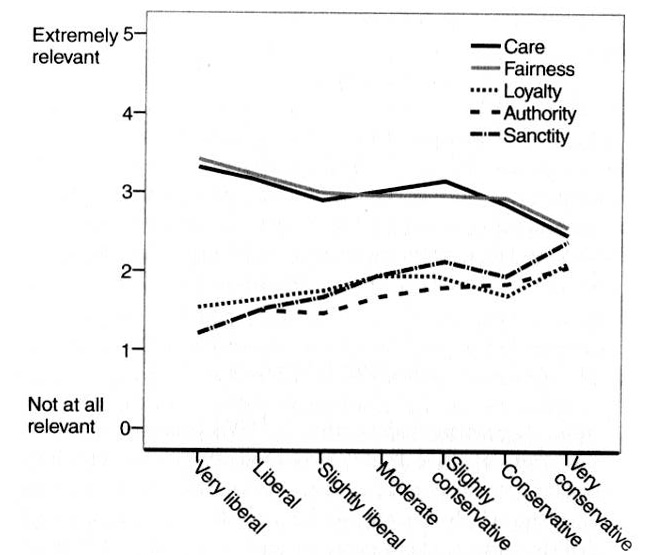
The graph above, which runs from “very liberal” to “very conservative,” shows how important the different foundations are to different kinds of people. Liberals are obsessed with fairness and caring, in the sense of looking after the weak, defective, and victims of oppression. They don’t care much about loyalty, authority, and sanctity. Conservatives, on the other hand, base their morality on all five foundations.

Prof. Haidt recognizes that liberals are fetishistic about “oppression:”

If you grow up in a WEIRD society, you . . . can detect oppression and inequality even where the apparent victims see nothing wrong. . . . For American liberals since the 1960s, I believe that the most sacred value is caring for victims of oppression. Anyone who blames such victims for their own problems or who displays or merely excuses prejudice against socialized victim groups can expect a vehement tribal response.

Prof. Haidt also notes that conservatives and liberals interpret “fairness” differently: “On the left, fairness implies equality, but on the right it means proportionality — people should be rewarded in proportion to what they contribute, even if that guarantees unequal outcomes.” Liberals worry that homosexuals can’t marry; conservatives resent welfare cheats.

For many liberals, equal opportunity is not enough; they want equal results. That is not possible in a capitalist society, so a deep hankering for equality is inherently socialist. This is why rural and working-class whites vote Republican. Liberals think Republicans have somehow duped blue-collar whites into voting against their own interests, but people who get their hands dirty for a living are offended by the liberal assault on merit, and they hate freeloaders.

Prof. Haidt and his colleagues have set up a website, YourMorals.org, where they get people to fill in questionnaires about their moral foundations, and have discovered something else: Conservatives understand the morals of liberals, but liberals do not understand those of conservatives. When conservatives are asked to answer questionnaires as if they were liberals, they generally get the motives right. When liberals pretend to be conservatives, they attribute incorrect, evil motives. This is not surprising; liberals think conservatives are not just wrong; they are moral inferiors.

Prof. Haidt and other researchers have found other differences. Liberals are reported to be more open to new things — people, food, music, etc. — while conservatives prefer the tried and true. Liberal professors give a narrower range of grades whereas conservative professors accept inequality, and give high grades to good students and flunk the worst. Liberals want dogs that are gentle and caring while conservatives want dogs that are loyal and obedient.

Prof. Haidt points out something else: the liberal foundations of morality put the individual before the group. Conservatives care about individuals, too, but they also value the authority, loyalty, and sense of sanctity that groups require. Despite Prof. Haidt’s instinctive liberalism, years of research have led him to see the importance of these group-oriented moral foundations. He certainly risks becoming anathema in his own circles by asking, “Might conservatives have a better formula for how to create a healthy, happy society?”

Prof. Haidt is also aware of studies that have found that conservatism and liberalism are heritable: About half the variation in this trait is heritable in men and somewhat less in women.

The importance of groups

Conservatives have a broader set of moral foundation because they recognize that humans are not atoms. For many people, their greatest satisfactions come from losing their identity and cooperating full tilt with the team, platoon, congregation, or cast of a musical. Altruism, devotion, and heroism cannot even exist in the absence of groups.

Prof. Haidt believes that group-level selection has had an undeserved bad name for the last several decades, and that humans really did evolve in ways that selected for tribal altruism. Groups in which members were willing to sacrifice outcompeted other groups. Prof. Haidt therefore argues that we have evolved both to be selfish and deceitful — which we are most of the time — but that under the right circumstances we can devote ourselves wholeheartedly to others, and that this is what makes us so different from all other mammals.

It is the ability to communicate and share intentions that makes us unique. Although chimps are our closest relatives, they are incapable of even the simplest kinds of cooperation. One chimp never holds down a springy branch while another picks off the fruit. Once we became able to cooperate — and Prof. Haidt thinks that happened 600 to 700 thousand years ago — it became much easier to get food, rear children, and raid other tribes.

As cooperation became the norm, rules had to be laid down, and rule-breakers had to be punished. The most basic rule is loyalty, and that is why people hate traitors more than they hate avowed enemies. Men are more tribal and group-oriented than women, who tend to be more loyal to two-person groups.

Prof. Haidt notes that the key to making any group work better is to “increase similarity, not diversity,” because people trust people who are like themselves. He says Orthodox Jews can run diamond markets efficiently and without elaborate security because they trust each other — because they are so similar. He adds that for any group, singing songs and marching together makes people feel more similar and this increases trust. He then says the one genuinely stupid (or perhaps just cravenly tactical) thing in the whole book: “There is nothing special about race. You can make people care less about race by drowning race differences in a sea of similarities, shared goals, and mutual interdependence.” The Army claims to do this, but this is a transparently false claim.

All societies have to balance the interests of the group and the individual, and WEIRD people put the individual first. This is very recent and far from universal — Prof. Haidt wonders if it may not be a reaction to the excesses of communism and fascism — and he realizes that it is risky to break down groups. When people really are unconnected individuals, cooperation fades.

Groups necessarily exclude outsiders, and it is the rare American academic who is willing to write kindly about any exclusive undertaking. Prof. Haidt concedes that groups can hurt each other — sometimes they exterminate each other — but argues that they do more good than harm: “[I]ntergroup competition increases love of the in-group far more than it increases dislike of the out-group.”

Prof. Haidt realizes that an essential group dynamic is the conviction that members of other groups are not quite right — wrong, misguided, or somehow defective — but insists that “we need groups, we love groups, and we develop our virtues in groups.” Then, whether he knows it or not, he says something dangerous: “Might the world be a better place if we could greatly increase the care people get within their existing groups and nations while slightly decreasing the care they get from strangers in other groups and nations?”

This is obviously true. If American blacks would marry each other instead of mugging and killing each other, it would do infinitely more good than handouts from white people. If Haitians could work together they would not need foreign aid. Unfortunately, stating the obvious is called “blaming the victim” (and may also be asking the impossible), and it is the very opposite of the current orthodoxy that requires rich white people at least to pretend to care deeply about distant people who are utterly unlike themselves.

Religion

Prof. Haidt makes another bold foray into heterodoxy in recognizing the importance of religion in holding societies together. He thinks religion arose as a mechanism to set the rules for a smooth-running moral community and to bind people to its values. If people believe in omniscient gods they are less likely to cheat when no one is looking, and a common set of rules creates trust — what psychologists call “social capital.” This is the key to getting large numbers of people to cooperate with others who are not immediate kin. Prof. Haidt quotes David Wilson, a biologist at Binghamton University: “Religions exist primarily for people to achieve together what they cannot achieve on their own.”

The recent evolution of our species took place within a thick matrix of morality, much of it religious. We worked, lived, traded, and mated in accordance with this moral matrix, even though we had to sacrifice “personal growth,” and other such self-centered fads. Rituals and sacred practices encourage people to sacrifice and to feel they are in the presence of something profound.

Prof. Haidt notes that many utopian communes were started in the 19th century, but it was the ones run on explicitly religious lines that survived best. Communes with religions that demanded the most sacrifice lasted longest. When sacrifice did not have a religious justification, commune members wanted to know what was in it for them.

Prof. Haidt reports that religious people give more to charity than non-religious people, although much of their giving goes to the religious group. By “religious,” however, he does not mean depth of conviction but depth of commitment, how enmeshed people are in their congregations. It is belonging, more than believing, that builds up social capital. People who are religious in this way also do more volunteer work, are better neighbors and citizens, and contribute proportionately more to non-religious charities, such as medical research foundations. “Religion in the United States,” writes Prof. Haidt, “nowadays generates such vast surpluses of social capital that much of it spills over and benefits outsiders.”

This is a remarkable statement for an academic. On most campuses, serious Christians are just one step up from “racists” (Buddhists, Hindus, and Muslims are exempt because they are usually not white), but Prof. Haidt does not to hesitate to draw the logical conclusion. Now, for the first time in history, we have societies that are, for all practical purposes, atheist. Prof. Haidt warns that “they are the least efficient societies ever known at turning resources (of which they have a lot) into offspring (of which they have few).”

Prof. Haidt writes that the left makes a great mistake in overlooking the importance of religion and of other group-derived sources of loyalty and morality:

Moral communities are fragile things, hard to build and easy to destroy. When we think about very large communities such as nations, the challenge is extraordinary and the threat of moral entropy is intense.

Prof. Haidt does not fail to note that the threat of moral entropy is especially intense in diverse societies. He goes on to issue a few valuable warnings to the left:

“If you destroy all groups and dissolve all internal structure, you destroy your moral capital.” If “you do not consider the effects of your changes on moral capital you’re asking for trouble. This, I believe is the fundamental blind spot of the left. It explains why liberal reforms so often backfire . . . .” “Loyalty, Authority, Sanctity,” the moral foundations the left ignores, “have a crucial role to play in a good society.”

The left has learned nothing from the grisly failure of communism, and continues to destroy moral capital by pushing “diversity,” feminism, atheism, equal outcomes, hedonism, and homosexuality, not only in the West but in societies that are still attached to tradition.

Ultimately, argues Prof. Haidt, moral systems are anything that helps people trust each other and work together. These systems are valuable even if they make no sense to outsiders. They are not rules about “justice” or “rights;” they may not be sets of rules at all. They are relationships, practices, traditions, expectations, and rituals that have grown up over time and in which people find the place that suits them. They are not mere social conventions that can be swept aside like old rubbish. Individuals do not have the capacity, all by themselves, to puzzle out consistent patterns of good behavior.

Nor does the same moral matrix work everywhere. “Beware of anyone,” writes Prof. Haidt, “who insists that there is one true morality for all people, times, and places.” That, of course, is precisely the kind of system we are left with in a “multi-cultural,” “diverse” society that is determined to overthrow every ancient or particularist norm.

What this means for us

Prof. Haidt writes that it is only people in WEIRD societies (Western, educated, industrialized, rich, and democratic) who have rule-based moralities and who value individuals over groups. They are also the only people who have devalued the racial or national group to the point where they talk cheerfully about dispossession. No one else spouts nonsense about the wonders of diversity.

But not all Western people have been denatured. Less-educated and poorer whites, and those living in Eastern Europe are less likely to have a WEIRD morality and less likely to have lost racial or ethnic consciousness. There is probably a strong relationship between living in a rich, industrialized country, and putting the individual over the group, since there has to be a lot of wealth for each nuclear family and for many single adults to have their own homes. Voting rather than clan-based power struggles also devalues the group. Significantly, though, these things have not destroyed group consciousness in rich Eastern countries such as Japan and Korea. It may be that anything that increases an awareness of the importance of groups increase awareness of the importance of race.

Prof. Haidt wrote this book in part to understand why well-meaning people cannot agree, and why they disagree so vehemently. He concludes that self-righteousness and the denigration of others is part of the way morality works, but that if we understand this it may make it easier for us to tolerate disagreement. He argues that both liberals and conservatives (would he stretch that to include “racists”?) are convinced they are trying to do the right thing, but their very conviction prevents them from recognizing their opponents’ good will.

This is surely true. Racially conscious whites are exquisitely aware of how liberals misattribute our motives and distort our positions. And yet, if they listen carefully to how their comrades or conventional conservatives talk about liberals, they will hear similar distortions.

A great many people are misguided, but very, very few are evil. By their lights, they are doing what is right. In our fight for survival, I’m not sure what good it does to realize that those who are even unintentionally destroying us are convinced they have worthy motives, but it is so. “We often have the urge to attribute ulterior motives to our opponents,” notes Prof. Haidt. “This is usually an error.” It would be useful if this book made liberals stop and consider how recklessly they attribute malevolence to their opponents.

Prof. Haidt is also unquestionably right when he says that moral arguments rarely change people’s minds. The whole purpose of American Renaissance is to make moral arguments and to present the facts on which these arguments are based. To us, what we say is factually irrefutable and profoundly moral, but liberals are deaf to our arguments and blind to our facts. That is the way the moral mind works.

But to the extent arguments do work, they have to reach what Prof. Haidt calls the elephant, the emotions. That is why racially conscious whites must avoid the slightest hint of anger or mean-spiritedness. This is almost impossible when you are fighting for your life, but even people who are leaning our way and who need only a gentle push towards racial consciousness will be pushed the other way by bitterness, sarcasm, or rudeness. That may amuse the comrades, but our purpose is not to amuse the comrades. It is to reach enough whites to build the movement that will be required if we are to survive.

As Prof. Haidt notes, many liberals have a queer notion of “fairness” that requires not just equal opportunity but equal outcomes. My guess is that to the extent our arguments make any sense to them at all, they must be based on something not too far removed from equal outcomes: Is it right for whites to be reduced to a minority while everyone else’s numbers grow? Is it right for whites to give up their homelands while other groups retain theirs? Is it right to require whites to sacrifice their interests — to deny they even have interests — while other groups promote theirs? At some muted, barely conscious level, appeals to reciprocity may get through to liberals.

Our task is particularly difficult because conventional thinking is now entrenched against us. Prof. Haidt writes that “the most effective way to design an ethical society is to make it so that everyone’s reputation is always on the line, so that bad behavior will have bad consequences.” This is undoubtedly true. The fatal flaw in our societies is that only “bad behavior” can ensure our survival.

As Prof. Haidt notes above, for liberals, “the most sacred value is caring for victims of oppression.” He is right — though by any historical standard, this is a peculiar value to elevate to top rank. Spouting nonsense about “diversity” is a ticket to respectability while telling the truth can cost you a job. At the same time, most people are conformists and cowards, and are experts at convincing themselves they are neither.

Genuine risk, combined with our species’ talent for self deception, makes dissent even more difficult and all the more necessary.

The post Why Everyone Else Is Wrong appeared first on American Renaissance.

pargentum: (Default)
[personal profile] pargentum
Бастрыкин заявил об активном применении ИИ в работе Следственного комитета

лифт

Feb. 15th, 2026 01:46 pm
avva: (Default)
[personal profile] avva
Тут в районной поликлинике есть лифт, он везет вверх только на один этаж. Едет он очень медленно, скорее ползет, а начинает движение так плавно (особенно опускаясь вниз), что то и дело сомневаешься, поехал ли ты. Только в самом конце есть толчок, словно время включают обратно.

Видимо, не одному мне мерещится всякое, так что повесили плакат в лифте.


Вам тоже стало завидно от "всегда прибывает в нужное время вовремя" и хочется так уметь? Без суеты, в медленном темпе, по-гидравлически?

Олимпиадное - пятое

Feb. 15th, 2026 12:25 pm
hina_chleck: (Default)
[personal profile] hina_chleck
 Очередное вчерашнее олимпиадное можно охактеризовать двумя словами: было весело.
- ладно, фигурка - я смотрела вполглаза, но падений было порядка 5-6. Ну и фаворит дважды приземлился и помарки еще делал. Приятно за казаха - он прыгнул выше потолка и взял золото. Тренер, кстати, Урманов.

- лыжная эстафета явила падение Эббы два раза на втором этапе, сломанную лыжу, пробег на одной ноге, падение бегущего к ней тренера с запасной лыжей... В итоге, Фрида вытянула на четвертое место на третьем этапе, но разрыв более минуты от норвежек, летящих алыми стрелами, привезла. Суннлинг сумела выгрызть второе место на финише - и даже подсократить разрыв от Венг.
Надеялась на злобноватость Юнны и побивание палками своих подруг на финише, но скандалезности не было, а жаль. В раздевалке побила?

Шведки стояли на подиуме с лицами под цвет их черных курток и штанов, финки были счастливы третьим местом.

- рада за Марен с золотом в спринте. Вторые-третьи Мишлон и Жанмонно беспрерывно попадали в объятия тренеров и стаффа, чего не было у Симон, повторюсь.

- сегодня мужская лыжэстафета + пасьюты мужчин и женщин в биатлоне. Отличная программа.

Мосс бывает хорош

Feb. 15th, 2026 02:27 pm
pargentum: (Default)
[personal profile] pargentum
https://users.livejournal.com/-moss/2330182.html

Пришли в голову слова – выскажись
Твои слова достанутся людям
С достаточно предсказуемыми последствиями
Промолчи – и они достанутся
Невидимым потусторонним сущностям
С последствиями непредсказуемыми
Непорядок

Иранский репортаж

Feb. 15th, 2026 12:28 am
[syndicated profile] lapot_feed
Эпиграф:
1915 год: молодой городовой ведёт молодого большевика в тюрьму
1918 год: молодой большевик ведёт молодого городового в тюрьму
1937 год: немолодой городовой с немолодым большевиком сидят в одной камере
1960 год: старый большевик продаёт на улице пирожки. К нему подходит старый городовой и спрашивает: ну что, царь-батюшка тебе мешал пирожками торговать?

Сегодня состоялось самое большое иранское ралли в Торонто в поддержку смены режима и признания принца Реза Пехлеви лидером нового, пост-аятольного Ирана. По оценкам полиции в ралли участвовало ок. 350 тыс. человек. По нашим впечатлениям, ралли было отлично организовано: согласовано перекрытие движения на Янг Стрит (одна из основных городских магистралей) от Стилз до Шеппард (это ок. 4.5 км), кроме полицейской охраны через каждые 70-100 метров по обе стороны дороги стояли небольшие хорошо обозначеные (с надписями на одежде) орг. группы - следили за порядком, один из каждой группы нон-стоп кричал к.-то кричалки на фарси, охотно подхватываемые демонстрантами; над головой летал самолётик с развивающимся лозунгом "Make Iran great again", на каждый пролёт вся масса людей останавливалась и чего-то скандировала (мы не поняли, т.к. фарси)

Основная масса плакатов была посвящена принцу Реза - портреты, лозунги, пожелания долгой жизни и пр. Много портретов погибших в течение последнего месяца участников протестов в Иране с указанием возраста (красивые молодые лица, мальчики-девочки :() Всякие плохие слова про нынешний режим. Призывы к Трампу не идти на переговоры с аятоллами, а действовать решительно. Кроме шахских иранских флагов то и дело мелькали израильские и американские, мы из любоытства подошли и посмотрели кто их нёс - не израильтяне и не американцы :)), а люди иранской диаспоры.

Люди вели себя очень спокойно, приветливо, дружелюбно; вроде никаких эксцессов. Натащили полицейским цветов, открыток с обьяснениями в любви и уважении, к.-то печенье/донатсы, кофе.

Дальше будут наши фотографии (много) с мероприятия (видео почему-то не грузится, а жаль), а так же ссылки на другие источники.


20260214_182823145_iOS.jpeg

20260214_183508330_iOS.jpeg

20260214_183518604_iOS.jpeg

20260214_184101024_iOS.jpeg

20260214_183002153_iOS.jpeg

20260214_184546253_iOS.jpeg

20260214_185116675_iOS.jpeg

20260214_185533156_iOS.jpeg

20260214_185801160_iOS.jpeg

20260214_190230703_iOS.jpeg

20260214_183104437_iOS.jpeg

20260214_185048975_iOS.jpeg

20260214_190345557_iOS.jpeg

20260214_193045484_iOS.jpeg

Ну и напоследок - полицейская машина в цветах, сердечках и записочках.

20260214_193549125_iOS.jpeg


Другие источники:

Канадское новостное агентство СВС
https://www.cbc.ca/news/canada/toronto/iran-support-rally-toronto-february-14-2026-9.7090479

Чужое видео:

https://www.instagram.com/reel/DUwTSn8CTsQ/
avva: (Default)
[personal profile] avva
Японский генерал Тадамити Курибаяси командовал гарнизоном на острове Иводзима. Мне показалось примечательным одно из его писем семье, точнее конкретно младшей дочери Такако, которую он называл Тако-чан, ей в то время было 10 лет.

====================
18 января 1945 года

Тако-чан,

Как у тебя дела? У меня всё хорошо. Твоя мать недавно написала мне и сообщила, что ты получила одни пятёрки в школе. Это очень меня обрадовало. Продолжай так же хорошо учиться и старайся всегда получать только пятёрки. Но постарайся помнить, что хорошие оценки в сельской школе не обязательно гарантируют хорошие оценки в токийской школе. Поэтому никогда не будь высокомерной и не переставай стараться. Ещё одна важная вещь — оставаться физически крепкой и быть человеком, который нравится всем.

Одних только учебных успехов недостаточно, чтобы завоевать друзей. Ты должна быть внимательна к другим и никогда не быть злой или язвительной. Это очень важно помнить, когда ты взрослеешь, особенно для молодых женщин. Я надеюсь, что ты сохранишь свое здоровье и станешь человеком, которого все любят.
Тадзоэ-сан смог на днях посетить Токио; без сомнения, его отец был очень счастлив его видеть. Я сам не могу уехать. Бои становятся всё ожесточённее, и я боюсь, что не смогу вернуться живым. Если так случится, пожалуйста, слушайся мать, взрослей как можно быстрее и отомсти за мою смерть.

Прощай. Береги себя и не простужайся.
От отца
====================

Курибаяси погиб во время обороны Иводзимы от американцев два месяца спустя. Атаку на этот остров помнят сегодня в основном благодаря знаменитой фотографии, на которой американцы водружают флаг на вершине горы на покоренном острове, а также фильму Клинта Иствуда 2006 года "Письма с Иводзимы". Письма Курибаяси семье издали в Японии почему-то только в 2000-х, английский перевод называется "Picture Letters From the Commander In Chief". Большая часть писем относится к 1928-1931 годам, когда Курибаяси учился в Гарварде, а его молодая жена с трехлетним первенцем осталась в Японии. Жена читала письма отца мальчику вслух и показывала картинки, которые он рисовал для иллюстрации (поэтому Picture Letters). К ВМВ и защите Иводзимы относятся только последние девять писем.

Эти письма (в английском переводе) вдохновили Клинта Иствуда на создание фильма (я его пока не видел).

Controversial waifu

Feb. 14th, 2026 03:08 pm
ugputu: (Default)
[personal profile] ugputu
По наводке [personal profile] kondybas

Если коротко, антимидасы большого брата оригинального 51 штата слепили "игру" преубогого вида, в котором лоховатый персонаж Чарли пытается избежать мутации в расиста и редиску, его сбивает с пути (в том числе) пошлоглупая крашеная сучка Нимфадора Амелия, ну а британская молодежь должна в игровой форме научиться колебаться синфазно с политикой партии. Неудвительно, что Амилия обожравшимся высокопарной пропаганды и повседневной херни ширнармассам запала в душу, и теперь утюпчик полон (сотни видео, в том числе производства других европейских стран с похожими проблемами) как альтернативными сценами из игры, так и бодрыми музыкальными перфомансами.

Программное заявление:


Изрядно провокационные и разнузданные сцены, имитирующие вышеупомянутую игру, и не менее провокационные веселые и лирические пестни Амилии и других несанкционированных девиц, ей подражающих, слепленные бесстыжыми крайне-правыми расистами, экстремистами и ксенофобами. Viewers discretion advised (c).  )

(no subject)

Feb. 14th, 2026 08:38 pm
[syndicated profile] galchi_feed
.


* * *

Все в этом мире случается,
Все непонятно для нас.
Пышною свадьбой кончается
Каждый хороший рассказ.


Вот понесли за невестою
Шлейф, и вуаль, и цветы.
Перед дорогою крестною
Стала прекраснее ты.

Узкие кольца меняются,
Сказано мертвое «да».
Повесть на этом кончается.
Падает с неба звезда
И на куски разбивается.


* * *

                           
                             Подумай, на руках у матерей
                                Все это были розовые дети.

                           
                                И.Анненский


Никто, как в детстве, нас не ждет внизу.
Не переводит нас через дорогу.
Про злого муравья и стрекозу
Не говорит. Не учит верить Богу.

До нас теперь нет дела никому –
У всех довольно собственного дела.
И надо жить, как все, но самому...
(Беспомощно, нечестно, неумело).


Анатолий Штейгер


February 2026

S M T W T F S
1234567
8910111213 14
15161718192021
22232425262728

Most Popular Tags

Style Credit

Expand Cut Tags

No cut tags
Page generated Feb. 15th, 2026 11:35 pm
Powered by Dreamwidth Studios